Programmatic Advertising Explained in Simple Terms
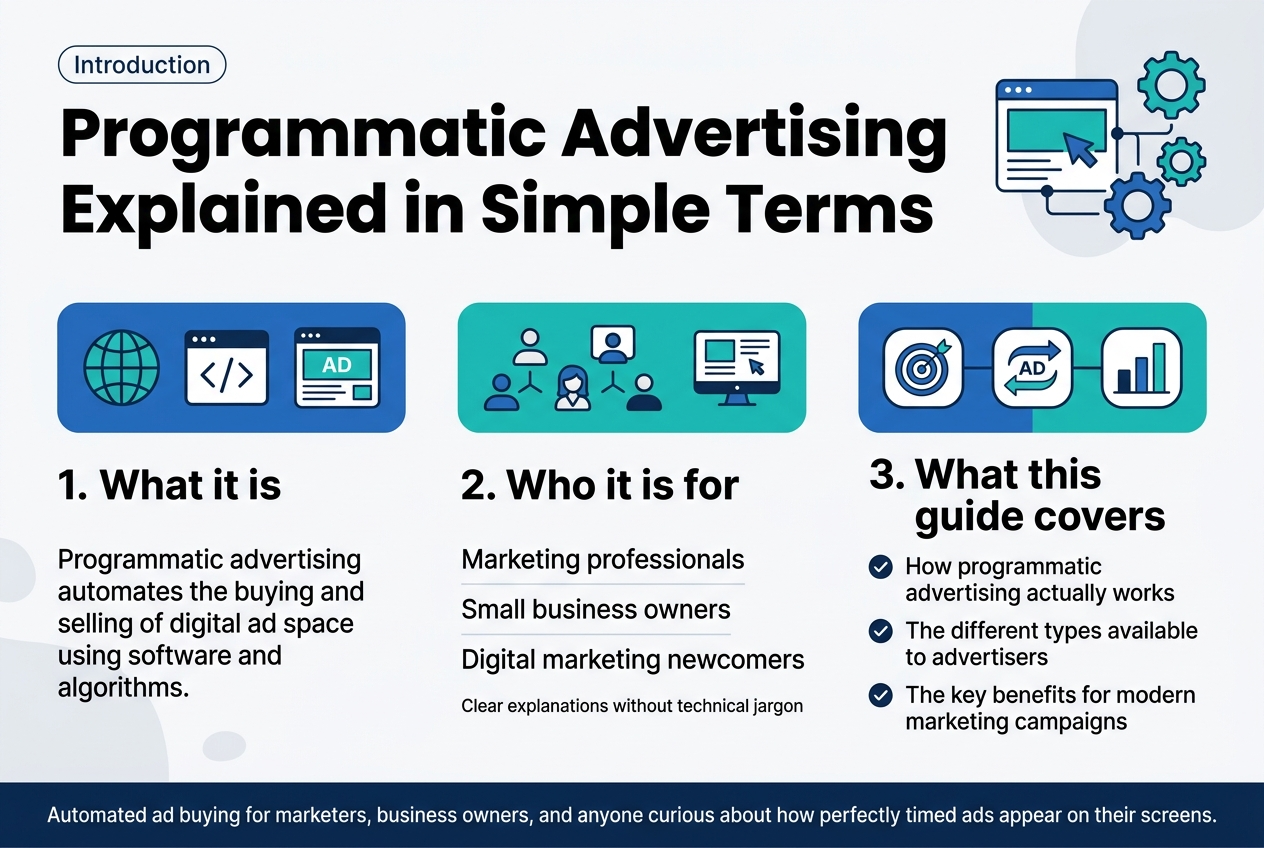
Programmatic advertising automates the buying and selling of digital ad space using software and algorithms. This guide breaks down the complex world of automated ad buying for marketers, business owners, and anyone curious about how those perfectly timed ads appear on their screens.
Who this is for: Marketing professionals wanting to understand programmatic basics, small business owners considering automated advertising, and digital marketing newcomers who need a clear explanation without the technical jargon.
We’ll cover the fundamentals of how programmatic advertising actually works, explore the different types available to advertisers, and examine the key benefits that make this technology a game-changer for modern marketing campaigns.
Understanding Programmatic Advertising Basics
What programmatic advertising means for your business
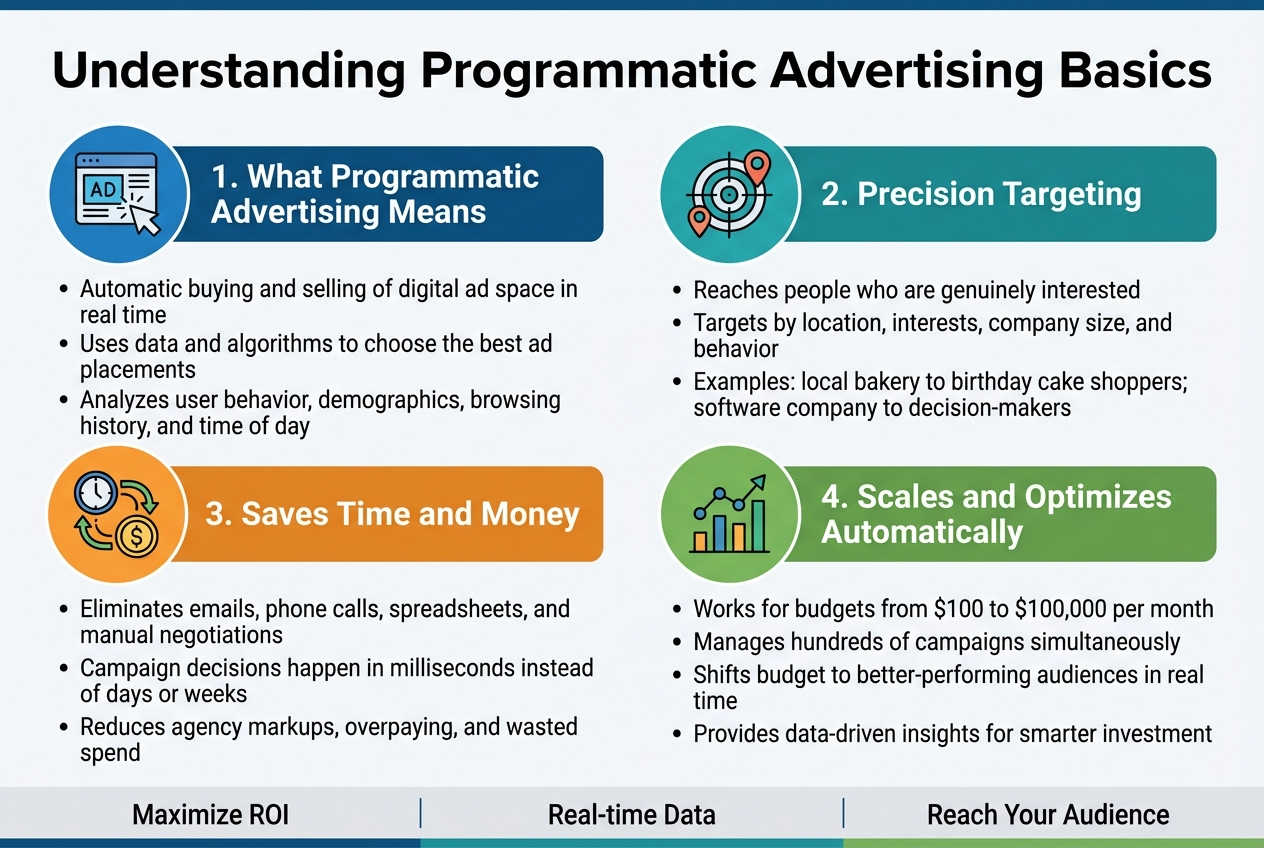
Programmatic advertising is essentially the automatic buying and selling of digital ad space in real-time. Think of it like having a super-smart assistant that handles all your ad purchases 24/7, making split-second decisions about where to place your ads and how much to pay for them.
For your business, this means your advertising dollars work smarter, not harder. Instead of manually negotiating with website owners or guessing which platforms will work best, programmatic systems use data and algorithms to find the perfect spots for your ads. These systems analyze thousands of factors in milliseconds – things like user behavior, demographics, browsing history, and even the time of day – to determine the best opportunities for your brand.
The beauty lies in precision targeting. Your ads reach people who are genuinely interested in what you offer, rather than casting a wide net and hoping for the best. A local bakery can target people searching for birthday cakes within a 5-mile radius, while a software company can reach decision-makers at companies of specific sizes. This level of targeting was nearly impossible with traditional advertising methods.
Programmatic advertising also scales with your business. Whether you’re spending $100 or $100,000 per month, the technology adapts to your budget and goals. Small businesses get access to the same sophisticated targeting tools that Fortune 500 companies use, leveling the playing field in ways that weren’t possible before.
How automated ad buying saves time and money
Manual ad buying used to involve countless emails, phone calls, and spreadsheets. Marketing teams would spend hours negotiating prices, coordinating insertion orders, and manually tracking campaign performance. Programmatic advertising eliminates this time-consuming process by handling everything automatically.
The time savings are massive. What once took days or weeks now happens in milliseconds. Your team can focus on strategy and creative development instead of administrative tasks. Campaign managers who previously spent 60% of their time on manual processes can now dedicate that time to optimizing campaigns and analyzing results.
Money savings come from multiple angles. First, you avoid the markups that traditional ad agencies and media buyers typically charge. Second, the real-time bidding system ensures you never overpay for ad space – the technology automatically finds the best deals available. Third, better targeting means less wasted spend on irrelevant audiences.
The efficiency gains are remarkable. Programmatic platforms can manage hundreds of campaigns simultaneously, adjusting bids and targeting in real-time based on performance data. This level of optimization is humanly impossible at scale. If one audience segment isn’t performing well, the system automatically shifts budget to better-performing segments without any manual intervention.
Budget flexibility becomes a reality with programmatic advertising. You can start small, test different approaches, and scale up what works. The technology provides detailed insights into which audiences, placements, and creative elements drive the best results, allowing you to make data-driven decisions about where to invest your advertising dollars.
How Programmatic Advertising Works Behind the Scenes
Real-time Bidding Process Simplified
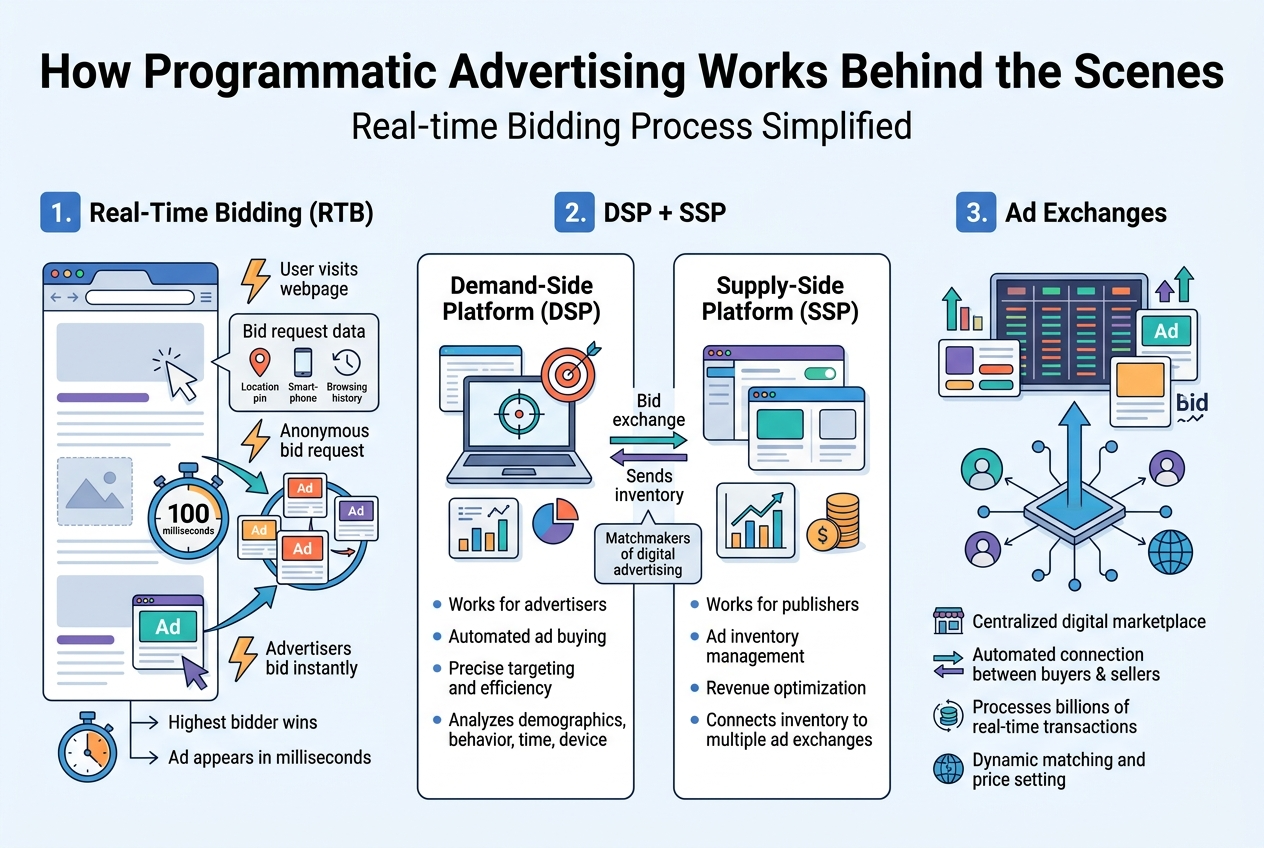
Picture this: you visit a news website, and in the milliseconds it takes for the page to load, dozens of advertisers are frantically bidding for the right to show you an ad. That’s real-time bidding (RTB) at work.
When you land on a webpage, your browser sends a bid request containing anonymous information about you—like your location, device type, and browsing history. This request gets broadcast to advertising platforms within 100 milliseconds. Advertisers use algorithms to instantly evaluate whether you’re their ideal customer and how much they’re willing to pay to reach you.
The highest bidder wins, and their ad appears on your screen before you even finish reading the first paragraph. The entire auction happens faster than you can blink. What makes this remarkable is that every single ad space on every website can trigger its own individual auction, creating millions of these lightning-fast bidding wars every second across the internet.
The beauty of RTB lies in its precision. Instead of buying ad space in bulk and hoping for the best, advertisers can target specific users at the exact moment they’re most likely to be interested. A sports equipment company might bid aggressively when someone visits a fitness blog but skip entirely when that same person browses cooking recipes.
Role of Demand-side Platforms and Supply-side Platforms
Think of demand-side platforms (DSPs) and supply-side platforms (SSPs) as the matchmakers of digital advertising. They’re the technology that makes those split-second auctions possible.
Demand-side platforms work for advertisers. They’re sophisticated software systems that manage ad buying across multiple websites and apps simultaneously. When you’re an advertiser with a campaign budget, your DSP acts like a super-smart personal shopper. It knows exactly who you want to reach, tracks down those people across the web, and bids on ad spaces where your target audience hangs out.
DSPs analyze massive amounts of data in real-time. They consider factors like user demographics, browsing behavior, time of day, and device type before deciding whether to bid on an ad placement. The best DSPs learn from every campaign, getting smarter about which placements deliver the best results for each advertiser.
Supply-side platforms represent the other side of the equation—they work for website owners and app developers who want to sell their ad space. If you run a popular blog or mobile app, an SSP helps you maximize revenue from your advertising inventory.
SSPs connect your available ad spaces to multiple ad exchanges and networks simultaneously, creating competition among advertisers. They analyze which types of ads perform best on your site and adjust pricing strategies to squeeze every penny from your traffic. Smart SSPs even predict which ad placements will generate the most revenue and prioritize those opportunities.
| Platform Type | Works For | Main Function | Key Benefit |
|---|---|---|---|
| DSP | Advertisers | Automated ad buying | Precise targeting and efficiency |
| SSP | Publishers | Ad inventory management | Revenue optimization |
Ad Exchanges as Digital Marketplaces
Ad exchanges are the bustling digital marketplaces where all this buying and selling happens. Imagine a stock exchange, but instead of trading company shares, participants trade individual ad impressions in real-time.
These platforms create a transparent, competitive environment where ad inventory gets bought and sold through automated auctions. Every ad space—whether it’s a banner on a news site, a video slot on a streaming platform, or a native ad in a social media feed—can be traded on these exchanges.
The major ad exchanges process billions of transactions daily. Google Ad Exchange, OpenX, and Rubicon Project handle massive volumes of ad inventory from publishers worldwide. They provide the technical infrastructure that makes programmatic advertising scalable, processing bid requests, conducting auctions, and facilitating payments between buyers and sellers.
What sets ad exchanges apart from traditional advertising networks is their transparency and efficiency. Publishers can see exactly how much their inventory sells for, while advertisers gain access to premium inventory they might never reach through direct relationships. The competition drives fair market pricing, and the automated nature eliminates much of the manual work that once bogged down digital advertising.
These exchanges also provide valuable data insights. They track which types of content attract premium advertising rates, help publishers optimize their ad placements, and give advertisers detailed performance analytics to improve their targeting strategies.
Types of Programmatic Advertising You Should Know
Open auctions for maximum reach
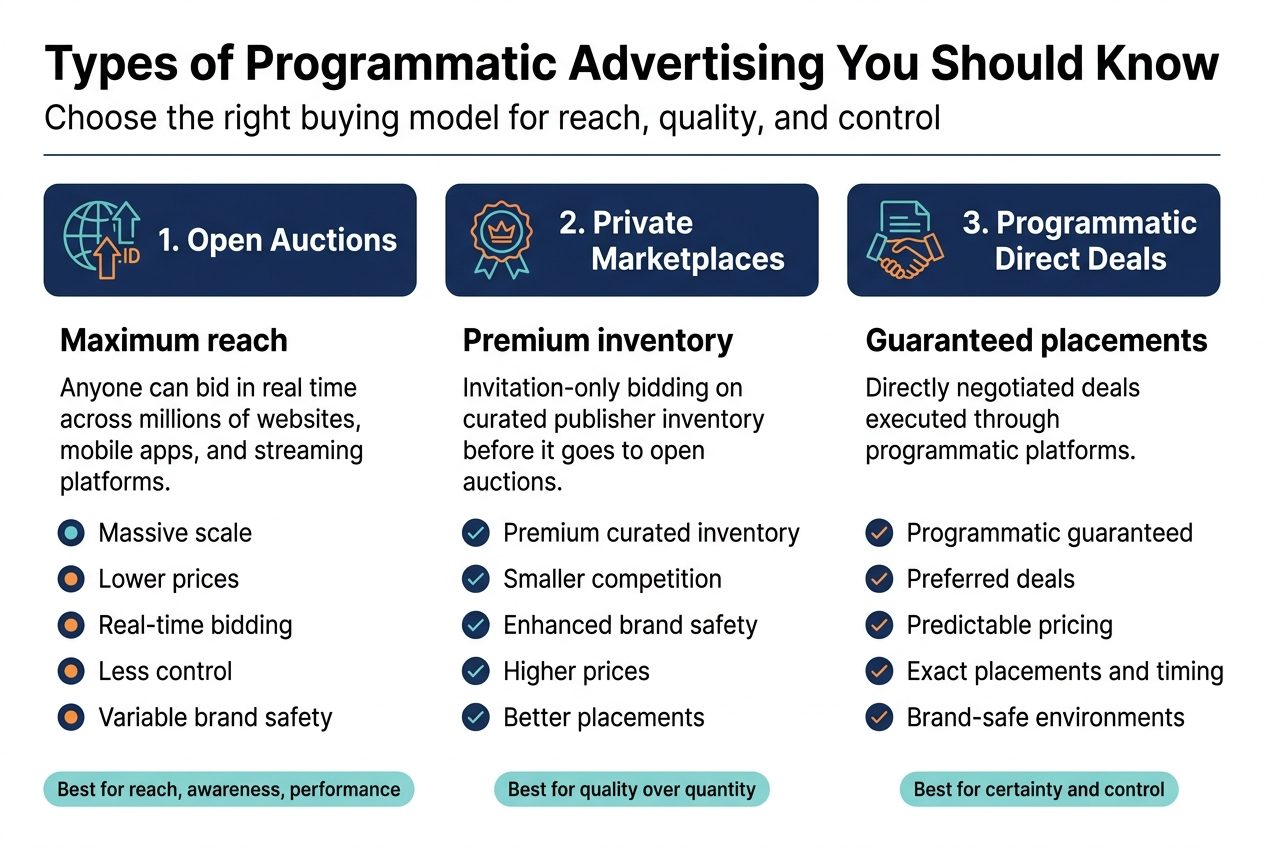
Open auctions represent the most accessible entry point into programmatic advertising. Think of them as the stock market for digital ad space – anyone with a programmatic platform can participate and bid on available inventory in real-time. When you run an open auction campaign, your ads compete alongside thousands of other advertisers for the same ad placements across websites, mobile apps, and streaming platforms.
The beauty of open auctions lies in their massive scale and cost efficiency. You get access to millions of websites and apps worldwide, often at lower prices than other programmatic methods. Real-time bidding happens in milliseconds, with algorithms automatically determining which ads appear based on factors like bid amount, relevance, and user data.
However, this openness comes with trade-offs. You have less control over exactly where your ads appear, and inventory quality can vary significantly. Brand safety becomes a bigger concern since your ads might show up on sites you wouldn’t normally choose. Despite these challenges, open auctions remain popular for campaigns focused on reach, awareness, and performance at scale.
Private marketplaces for premium inventory
Private marketplaces operate like exclusive clubs for advertisers and publishers. Publishers invite select advertisers to bid on their premium inventory before it goes to open auctions. This invitation-only approach creates a more controlled environment where both parties benefit from higher-quality partnerships.
For advertisers, private marketplaces offer access to premium publisher inventory that might never reach open auctions. You’re bidding against a smaller pool of competitors, often resulting in better placements and more favorable terms. Publishers maintain greater control over who advertises on their sites, protecting their brand reputation and commanding higher prices for their inventory.
| Feature | Open Auctions | Private Marketplaces |
|---|---|---|
| Access | Anyone can bid | Invitation only |
| Inventory Quality | Mixed | Premium/curated |
| Competition | High | Limited |
| Brand Safety | Variable | Enhanced |
| Pricing | Lower | Higher |
Private marketplaces work particularly well for brands that prioritize quality over quantity. You’ll pay more per impression, but you gain confidence knowing your ads appear alongside premium content on reputable websites. Many advertisers use private marketplaces to complement their open auction campaigns, allocating budget to both strategies based on their specific goals.
Programmatic direct deals for guaranteed placements
Programmatic direct deals bridge the gap between traditional media buying and modern programmatic technology. These arrangements involve direct negotiations between advertisers and publishers, but execution happens through programmatic platforms rather than manual insertion orders and email chains.
Two main types dominate this space: programmatic guaranteed and preferred deals. Programmatic guaranteed works like traditional direct buys – you negotiate a fixed price for a specific amount of inventory, but the delivery happens automatically through programmatic systems. Preferred deals give you first dibs on inventory at negotiated prices, though you’re not obligated to purchase.
The main advantage is predictability. You know exactly where your ads will appear, when they’ll run, and how much you’ll pay. This certainty makes budget planning easier and ensures your ads reach your target audience in brand-safe environments. Publishers love these deals because they provide guaranteed revenue and fill their premium inventory with known, trusted advertisers.
Programmatic direct deals require more hands-on management than automated auctions. You’ll spend time negotiating terms, managing relationships, and monitoring campaign performance. The trade-off is greater control and premium placement opportunities that automated bidding can’t always secure.
Benefits That Make Programmatic Advertising Worth Your Investment
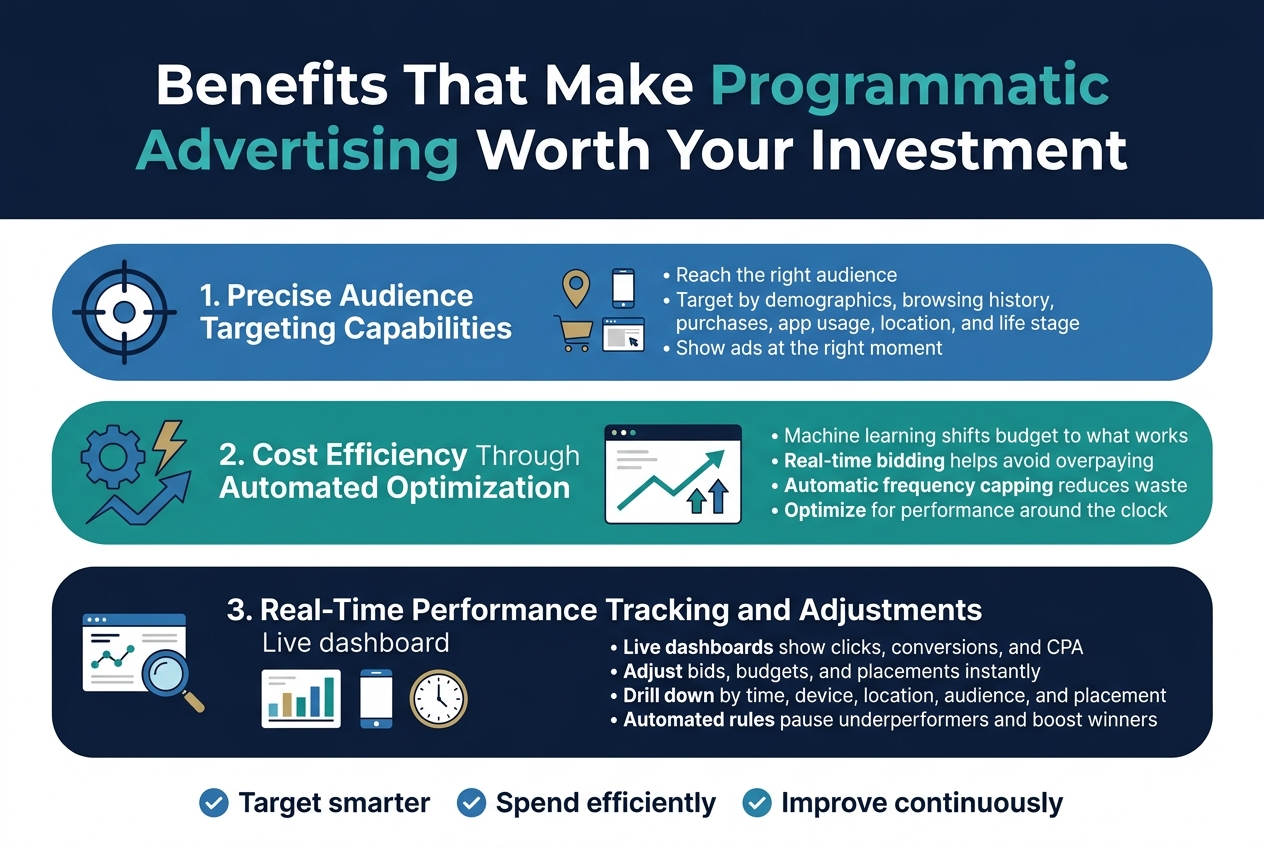
Precise Audience Targeting Capabilities
Programmatic advertising gives you superhuman powers when it comes to finding your ideal customers. Instead of casting a wide net and hoping for the best, you can pinpoint exactly who sees your ads based on incredibly specific criteria. Want to reach 25-34 year old dog owners who live in urban areas and have recently searched for premium pet food? You got it. Looking for busy parents who shop online after 9 PM and have household incomes above $75,000? Done.
The targeting options go way beyond basic demographics. You can target people based on their browsing history, recent purchases, app usage, location data, and even their current life stage. Someone who just moved to a new city? Perfect timing for your home services ad. A person who’s been researching vacation destinations? Your travel package could be exactly what they need.
This precision means your ads reach people who actually care about what you’re selling. You’re not wasting money showing baby formula ads to teenagers or luxury car commercials to college students. Every impression has the potential to convert because you’re speaking to the right person at the right moment.
Cost Efficiency Through Automated Optimization
Traditional advertising often feels like throwing money into a black hole. You set your budget, cross your fingers, and hope something sticks. Programmatic advertising flips this approach completely. The system constantly analyzes performance data and automatically shifts your budget toward the placements, audiences, and creative combinations that actually work.
Machine learning algorithms work around the clock to optimize your campaigns. If your ads perform better on mobile devices between 6-8 PM, the system notices this pattern and automatically bids higher during those peak times. Struggling to get clicks from a particular audience segment? The algorithm reduces spending there and redirects budget to segments showing better engagement.
Real-time bidding ensures you never overpay for ad placements. The system evaluates each impression opportunity in milliseconds, considering factors like audience quality, placement context, and your campaign goals before deciding how much to bid. You only pay what an impression is actually worth to your business, not some inflated rate card price.
Automated frequency capping prevents ad fatigue by limiting how often the same person sees your ads. This protects your budget from waste while maintaining a positive user experience.
Real-Time Performance Tracking and Adjustments
Gone are the days of waiting weeks to see how your campaign performed. Programmatic platforms provide live dashboards showing exactly what’s happening with your ads right now. You can see click-through rates, conversion rates, cost per acquisition, and dozens of other metrics updating in real-time.
This immediate feedback loop lets you make smart decisions fast. Notice your ads aren’t performing well on a particular website? You can exclude it within minutes. See a spike in conversions from mobile users? You can increase your mobile bidding strategy immediately. Spot a creative that’s dramatically outperforming others? You can shift more budget toward it before the day ends.
The data granularity is impressive. You can drill down to see performance by time of day, device type, geographic location, audience segment, and individual ad placements. This level of detail helps you understand not just what’s working, but why it’s working.
Campaign adjustments happen automatically too. If you’ve set up rules for optimization, the system can pause underperforming ads, increase budgets for high-converting audiences, or adjust bids based on performance thresholds you define. This automation means your campaigns keep improving even when you’re focused on other business priorities.
Common Challenges and How to Overcome Them
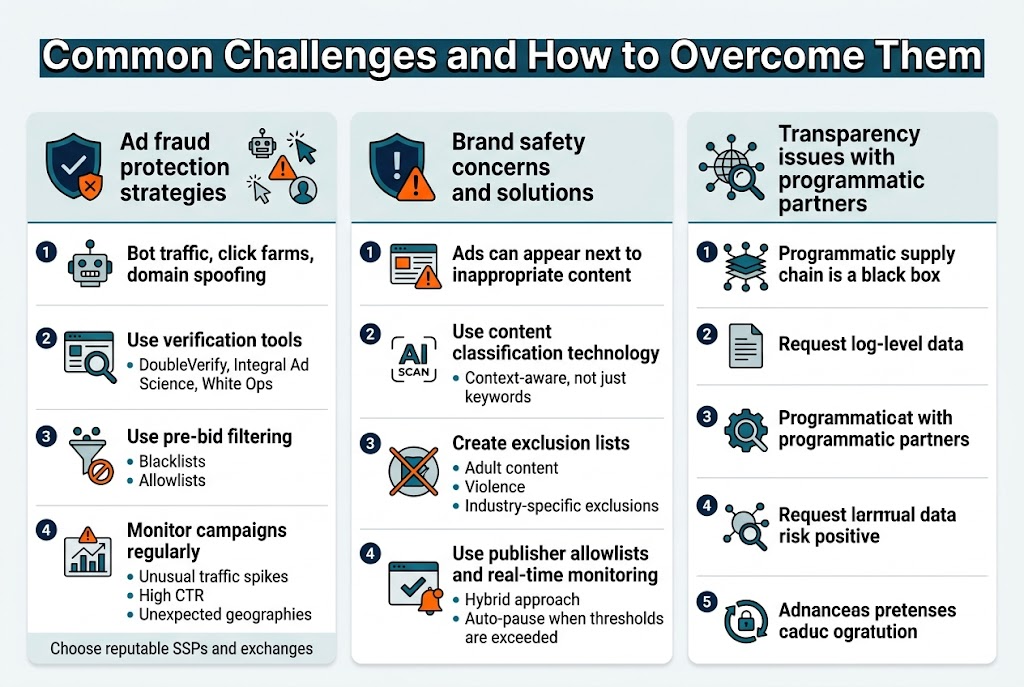
Ad fraud protection strategies
Digital advertising fraud costs businesses billions each year, making protection strategies essential for programmatic campaigns. Bot traffic, click farms, and domain spoofing represent the most common threats advertisers face today.
Implementing robust verification tools serves as your first line of defense. Third-party fraud detection platforms like DoubleVerify, Integral Ad Science, and White Ops monitor traffic patterns in real-time, flagging suspicious activity before it impacts your budget. These tools analyze user behavior, device fingerprints, and traffic sources to identify non-human interactions.
Pre-bid filtering blocks fraudulent inventory before you spend money on it. Set up blacklists for known bad actors and use allowlists to restrict your ads to verified publishers. Many demand-side platforms offer built-in fraud protection features that automatically exclude suspicious inventory sources.
Regular campaign monitoring helps catch fraud early. Watch for unusual spikes in traffic, abnormally high click-through rates, or conversions from unexpected geographic locations. These patterns often signal fraudulent activity that requires immediate investigation.
Working with reputable supply-side platforms and exchanges reduces exposure to fraud. Established players have stronger vetting processes and invest more heavily in fraud prevention technology. While premium inventory costs more upfront, it protects your advertising investment from waste.
Brand safety concerns and solutions
Brand safety mishaps can damage your reputation and erode customer trust within hours of going live. Programmatic advertising’s automated nature means your ads might appear next to inappropriate content without proper safeguards in place.
Content classification technology acts as your digital bodyguard, scanning web pages for potentially harmful material before your ads appear. Modern brand safety tools use artificial intelligence to understand context beyond simple keyword matching. They can distinguish between news articles about violence and violent entertainment content, ensuring your ads appear in appropriate environments.
Creating detailed exclusion lists prevents your brand from appearing alongside problematic content categories. Beyond obvious exclusions like adult content or violence, consider industry-specific concerns. A family restaurant chain might exclude content about food poisoning outbreaks, even if the articles themselves are legitimate news stories.
Publisher allowlists give you complete control over where your ads appear. While this approach limits scale, it guarantees your brand only appears on pre-approved, high-quality websites. Many advertisers use a hybrid approach, combining allowlists for core campaigns with broader targeting that includes robust safety filters.
Real-time monitoring tools alert you when brand safety issues arise. Set up automated notifications for when your ads appear in questionable environments, allowing quick response to potential problems. Some platforms offer automatic pause features that stop campaigns immediately when safety thresholds are exceeded.
Transparency issues with programmatic partners
The programmatic supply chain involves multiple intermediaries, creating a black box effect where advertisers struggle to understand where their money goes and how their ads are served.
Demanding log-level data from your programmatic partners provides granular visibility into campaign performance. This data includes specific websites where ads appeared, exact bid prices, and detailed audience information. Many advertisers don’t realize they can request this information, but most reputable platforms will provide it upon request.
Implementing ads.txt and sellers.json protocols helps verify legitimate inventory sources. These industry standards create transparency by allowing publishers to declare authorized sellers and enabling buyers to trace inventory back to its original source. Always check that your programmatic partners support these verification methods.
Fee transparency discussions should happen before signing contracts. Ask for detailed breakdowns of platform fees, data costs, and any additional charges. Some platforms offer transparent fee structures while others bundle costs together. Understanding exactly what you’re paying for helps optimize your programmatic investments.
Regular audits of your programmatic setup reveal hidden inefficiencies and unauthorized markups. Third-party audit firms specialize in programmatic transparency and can identify issues that internal teams might miss. These audits often uncover significant cost savings and performance improvements.
Choose partners who embrace transparency rather than those who hide behind proprietary algorithms. The best programmatic partners willingly share performance data, explain their optimization strategies, and provide clear answers about how your campaigns operate.
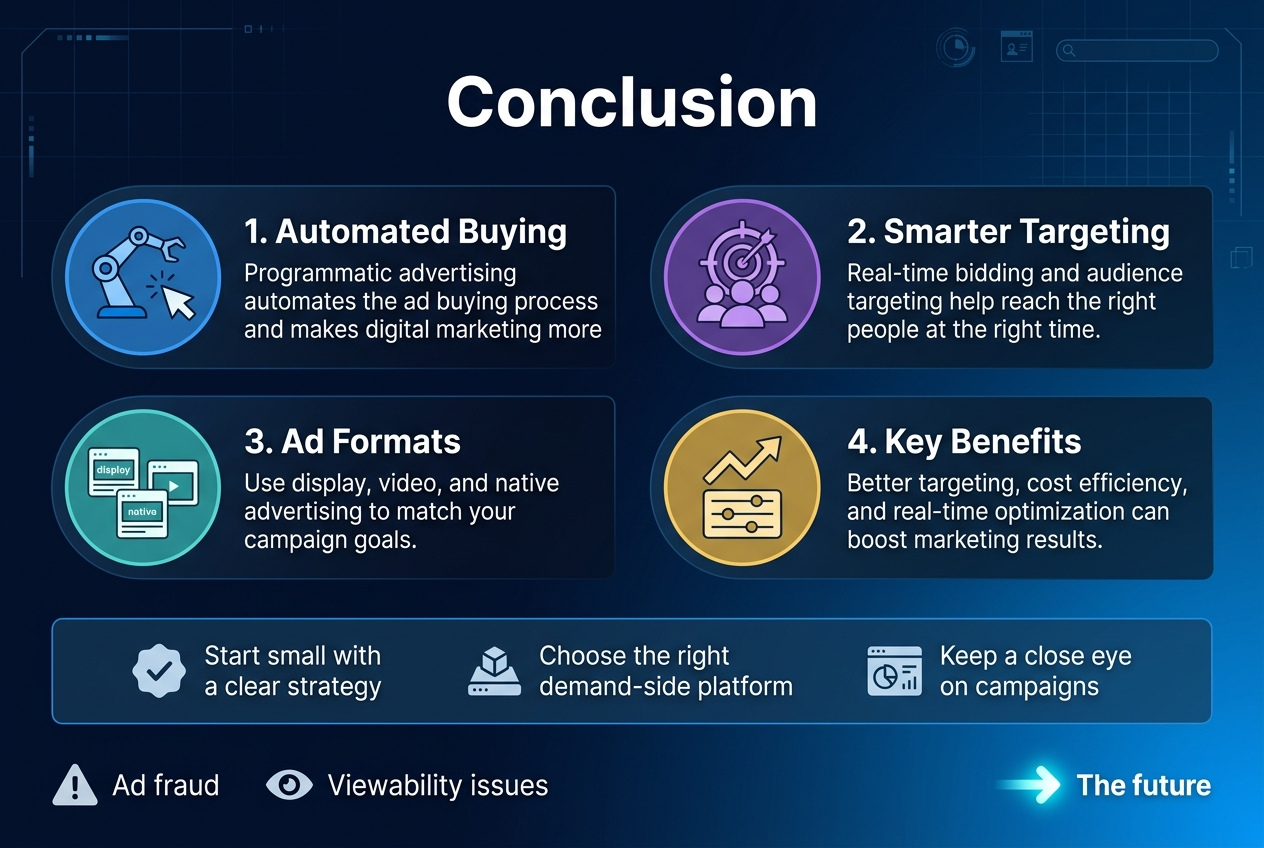
Programmatic advertising has transformed how digital marketing works by automating the ad buying process and making it more efficient than ever before. The technology handles everything from real-time bidding to audience targeting, while offering different approaches like display, video, and native advertising to meet your specific goals. The benefits are clear: better targeting, cost efficiency, and real-time optimization that can significantly boost your marketing results.
Getting started with programmatic advertising doesn’t have to be overwhelming. Start small with a clear strategy, choose the right demand-side platform for your needs, and keep a close eye on your campaigns as they run. While challenges like ad fraud and viewability issues exist, the right tools and knowledge can help you navigate them successfully. The future of digital advertising is automated, and now you have the foundation to make programmatic advertising work for your business.