Choosing between launching a startup or freelancing has become one of the most critical career decisions for entrepreneurs, recent graduates, and professionals considering a career change in 2026. Both paths offer unique advantages, but they require vastly different mindsets, resources, and risk tolerance levels.
This guide is designed for ambitious professionals who want to understand which option aligns better with their goals, financial situation, and lifestyle preferences. Whether you’re a college graduate exploring your options, a corporate employee ready to break free, or an experienced professional seeking more autonomy, this comparison will help you make an informed decision.
We’ll break down the key differences between startup and freelancing models, examining how each approach affects your earning potential and financial stability. You’ll also discover the market opportunities and emerging trends that could influence your success in 2026, plus learn which skills and personality traits give you the best shot at thriving in each path.
Key Differences Between Startup and Freelancing Models
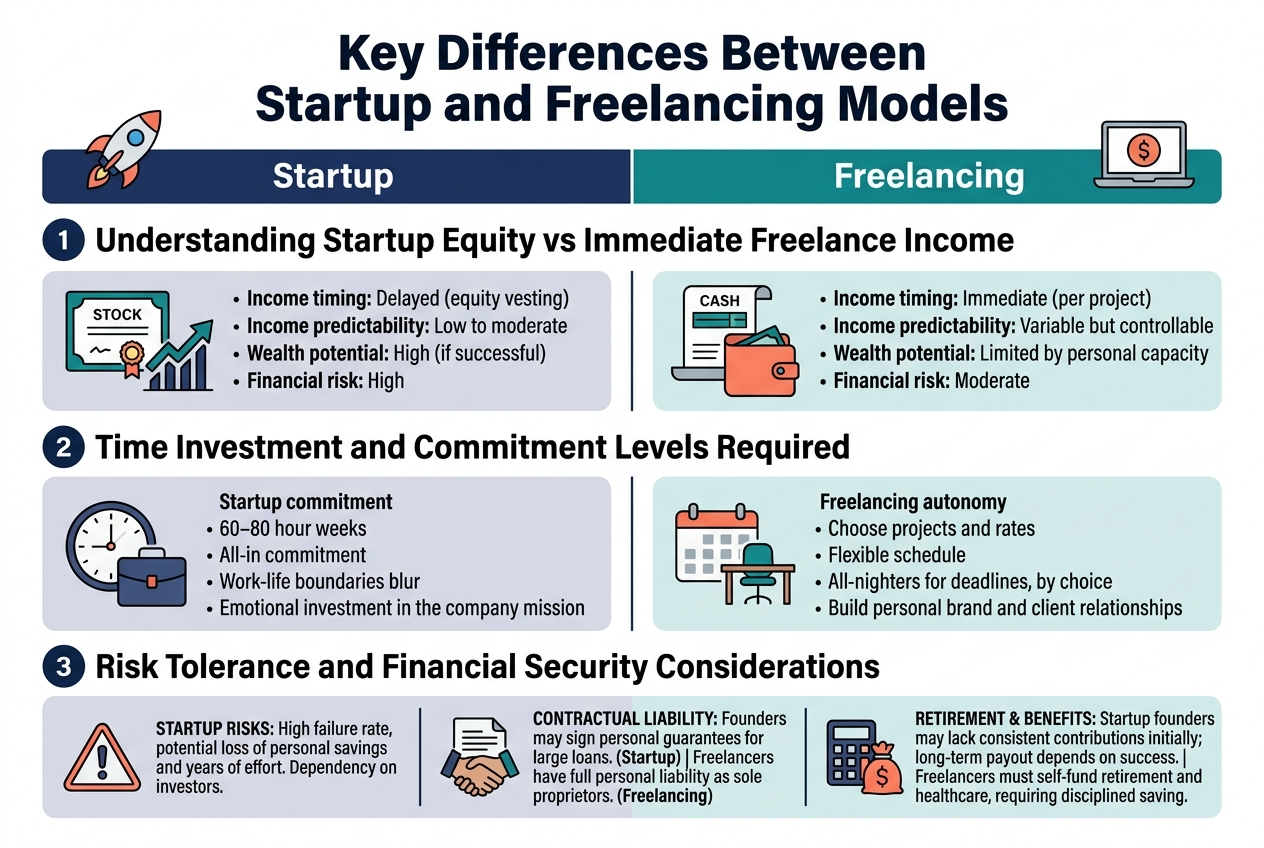
Understanding Startup Equity vs Immediate Freelance Income
The financial structures of startups and freelancing couldn’t be more different. When you join a startup, you’re often trading immediate financial security for potential future wealth through equity compensation. Your paycheck might be lower than market rate, but you receive stock options or equity shares that could become valuable if the company succeeds.
Freelancing offers the opposite dynamic – you get paid for every project completed, creating immediate cash flow. There’s no waiting for an exit event or hoping your equity becomes worth something. Your income directly correlates with your effort and ability to secure clients.
| Aspect | Startup | Freelancing |
|---|---|---|
| Income timing | Delayed (equity vesting) | Immediate (per project) |
| Income predictability | Low to moderate | Variable but controllable |
| Wealth potential | High (if successful) | Limited by personal capacity |
| Financial risk | High | Moderate |
Time Investment and Commitment Levels Required
Startups demand all-in commitment. You’re expected to work long hours, especially during critical phases like product launches or fundraising rounds. The “startup grind” is real – 60-80 hour weeks become normal, and work-life boundaries often blur. Your success ties directly to the company’s success, creating pressure to prioritize work above everything else.
Freelancing gives you control over your schedule, but successful freelancers often work just as hard. The difference lies in autonomy – you choose your projects, set your rates, and decide when to work. You might pull all-nighters to meet deadlines, but it’s your choice based on the clients and projects you accept.
The commitment extends beyond hours worked. Startups require emotional investment in the company’s mission and vision. You become part of building something larger than yourself. Freelancing focuses more on building your personal brand and client relationships.
Risk Tolerance and Financial Security Considerations
Your risk tolerance should heavily influence this decision. Startups represent high-risk, high-reward scenarios. Many fail within the first few years, potentially leaving you with worthless equity and below-market compensation history. However, successful startups can generate life-changing wealth through acquisitions or IPOs.
Freelancing offers more stable but limited earning potential. Your income ceiling depends on how many hours you can work and your hourly rates. Building a sustainable freelance business takes time, and client acquisition never stops. You’re essentially running a one-person business with all the associated risks.
Financial security looks different for each path. Startups might offer health insurance and benefits, but your equity could become worthless. Freelancers must handle their own benefits and taxes while managing irregular income flows. Smart freelancers build emergency funds and diversify their client base to mitigate these risks.
The age factor matters too. Younger professionals often have higher risk tolerance and fewer financial obligations, making startups attractive. Those with families or significant expenses might prefer freelancing’s more predictable income stream.
Financial Considerations for Each Career Path
Startup Funding Challenges and Equity Distribution
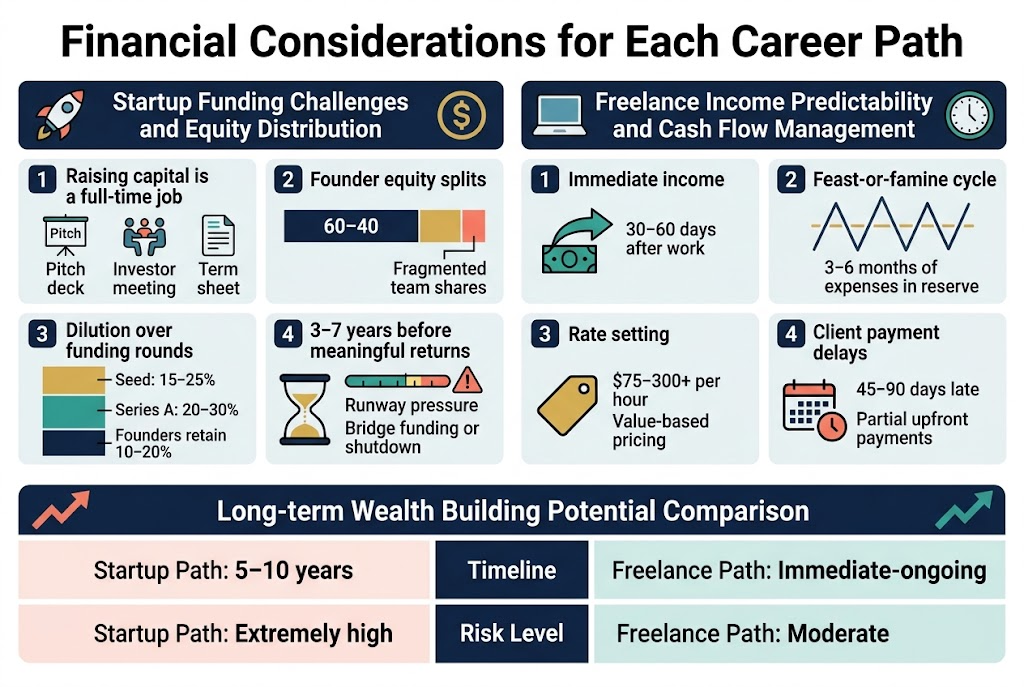
Raising capital for a startup feels like a full-time job on its own. You’ll spend countless hours crafting pitch decks, attending investor meetings, and navigating term sheets that seem designed to confuse rather than clarify. Most founders bootstrap initially, burning through personal savings while seeking that elusive first round of funding.
The equity game becomes particularly complex when bringing on co-founders and early employees. Typical founder equity splits range from 60-40 for two founders to more fragmented distributions with larger teams. Early employees might receive 0.1% to 5% equity stakes, but vesting schedules mean waiting four years to fully own those shares.
Dilution hits hard with each funding round. Seed rounds typically cost founders 15-25% of their company, while Series A can take another 20-30%. By the time you reach profitability, founders often retain just 10-20% ownership. The math works only if the company’s total value grows exponentially.
The timing pressure creates additional stress. Running out of runway means scrambling for bridge funding or facing potential shutdown. Unlike freelancers who can pivot quickly, startup founders often commit 3-7 years before seeing meaningful returns, if any materialize at all.
Freelance Income Predictability and Cash Flow Management
Freelancing offers immediate income but demands constant hustle. Your earnings directly correlate with billable hours and project rates, creating both opportunity and anxiety. Unlike startup founders waiting years for exits, freelancers see money hit their accounts within 30-60 days of completing work.
The feast-or-famine cycle defines freelance life. One month you’re turning down projects; the next, you’re scrambling to find new clients. Smart freelancers maintain 3-6 months of expenses in reserve and actively pursue recurring contracts or retainer agreements that provide steady income streams.
Rate setting becomes a psychological challenge. Underpricing yourself feels safer when starting out, but it creates unsustainable business models. Top freelancers charge $75-300+ per hour depending on their expertise and market positioning. The key lies in value-based pricing rather than hourly rates for complex projects.
Client payment delays can crush cash flow. Even well-intentioned businesses often pay 45-90 days late, leaving freelancers to bridge gaps with personal funds or credit lines. Setting clear payment terms and requiring partial upfront payments helps mitigate these risks.
Seasonal fluctuations affect many freelance markets. Marketing consultants see increased demand before product launches, while tax professionals peak during filing season. Building diverse client bases across industries helps smooth these natural cycles.
Long-term Wealth Building Potential Comparison
The wealth building trajectories between startups and freelancing differ dramatically in timeline and risk profile. Successful startup exits create life-changing wealth through equity appreciation, while freelancing builds wealth through consistent income reinvestment and business scaling.
Startup wealth creation follows a power law distribution. Most ventures fail completely, returning nothing to founders. However, successful exits can generate millions or even billions in founder wealth. Consider that even a 5% stake in a $100 million exit equals $5 million – far exceeding what most freelancers earn over entire careers.
| Wealth Factor | Startup Path | Freelance Path |
|---|---|---|
| Timeline | 5-10 years | Immediate-ongoing |
| Risk Level | Extremely high | Moderate |
| Potential Upside | Unlimited | High but capped |
| Income During Building | Minimal/none | Consistent |
| Passive Income Potential | High post-exit | Low-moderate |
Freelancers build wealth through different mechanisms. Top consultants earning $200,000+ annually can invest consistently in traditional assets. Some transition into productized services, courses, or software tools that scale beyond personal time investment. The freelance-to-agency model allows hiring other freelancers, creating management fees and profit margins.
Tax advantages differ significantly between the paths. Startup founders often qualify for Section 1202 qualified small business stock exemptions, potentially excluding up to $10 million in gains from federal taxes. Freelancers face self-employment taxes but enjoy numerous business deductions and retirement account options like SEP-IRAs.
Real estate investment becomes more accessible for freelancers with steady income streams. Banks prefer W-2 income for mortgage approvals, making it challenging for startup founders to qualify for loans during their venture-building years. Freelancers can pursue rental properties, REITs, and other real estate strategies while maintaining their primary business.
The compound effect favors early, consistent investing. Freelancers who invest $2,000 monthly from age 25-35 often outperform startup founders who wait until age 35 to invest larger lump sums from exits. Time in market typically beats timing the market, giving steady earners a mathematical advantage despite lower absolute amounts.
Market Opportunities and Trends Shaping 2026
Remote Work Revolution Impact on Both Models
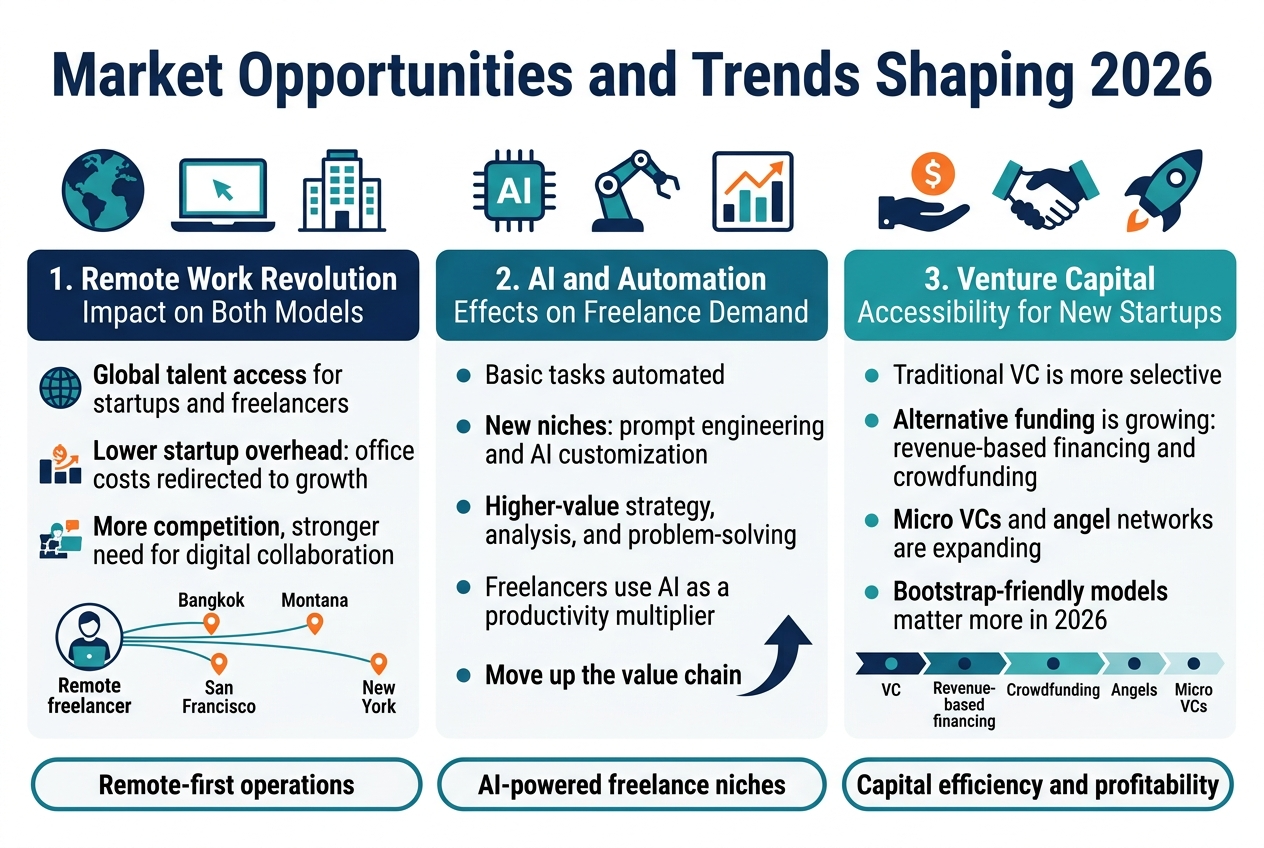
The remote work landscape has completely transformed how both startups and freelancers operate. Companies that once required physical offices now embrace distributed teams, creating massive opportunities for location-independent professionals. Freelancers can now tap into global markets without geographical constraints, competing for high-value projects across continents. A developer in Bangkok can easily work for a San Francisco startup, while a marketing specialist in rural Montana can serve clients in New York.
For startups, remote-first operations slash overhead costs dramatically. Instead of spending $50,000 annually on office space, that capital can fund product development or marketing initiatives. This shift enables lean operations and faster scaling, though it requires new management skills and digital collaboration tools.
The gig economy platforms have matured significantly, with specialized marketplaces emerging for niche skills. Platforms like Toptal for elite developers or 99designs for creative work offer freelancers access to premium clients while providing startups with vetted talent pools.
However, remote work has intensified competition. Freelancers now compete globally, putting pressure on pricing in developed markets. Startups face challenges building company culture and maintaining team cohesion without physical presence.
AI and Automation Effects on Freelance Demand
Artificial intelligence is reshaping freelance opportunities in unexpected ways. While AI tools eliminate some traditional tasks like basic content writing or simple graphic design, they’re simultaneously creating new categories of work. AI prompt engineering, machine learning model training, and AI tool customization have become lucrative freelance specialties.
Creative fields show interesting patterns. AI can generate basic logos or write simple blog posts, but complex brand strategy, nuanced copywriting, and sophisticated design still require human expertise. Smart freelancers are learning to use AI as a productivity multiplier rather than viewing it as competition.
Data analysis and AI implementation consulting represent growing opportunities. Small businesses need help understanding and implementing AI solutions but can’t afford full-time specialists. This creates perfect freelance niches for professionals who understand both the technology and business applications.
The key shift is toward higher-value, strategic work. Basic execution tasks increasingly get automated, while planning, strategy, and complex problem-solving remain human domains. Freelancers who adapt by moving up the value chain will thrive, while those clinging to routine tasks face displacement.
Venture Capital Accessibility for New Startups
The venture capital landscape in 2026 presents mixed signals for new startups. Traditional VC funding has become more selective, with investors focusing on proven business models and experienced teams. The easy money era of 2020-2021 is over, replaced by rigorous due diligence and profitability expectations.
However, alternative funding sources have expanded significantly. Revenue-based financing allows startups to raise capital without giving up equity, particularly attractive for businesses with predictable cash flows. Crowdfunding platforms have matured, enabling consumer-focused startups to validate markets while raising funds.
Micro VCs and angel investor networks have proliferated, creating more early-stage funding opportunities. Geographic barriers have diminished, with remote pitch processes now standard. A startup in Austin can easily access Silicon Valley investors, while European VCs regularly invest in American companies.
The funding environment favors certain sectors. Climate tech, healthcare innovation, and enterprise software continue attracting significant investment. Consumer apps face tougher scrutiny unless they demonstrate clear paths to profitability.
For entrepreneurs, this means building businesses that can achieve profitability with minimal external funding has become more valuable. Bootstrap-friendly business models and clear revenue generation from day one are increasingly important for startup success.
Skills and Personality Traits for Success
Entrepreneurial mindset requirements for startups
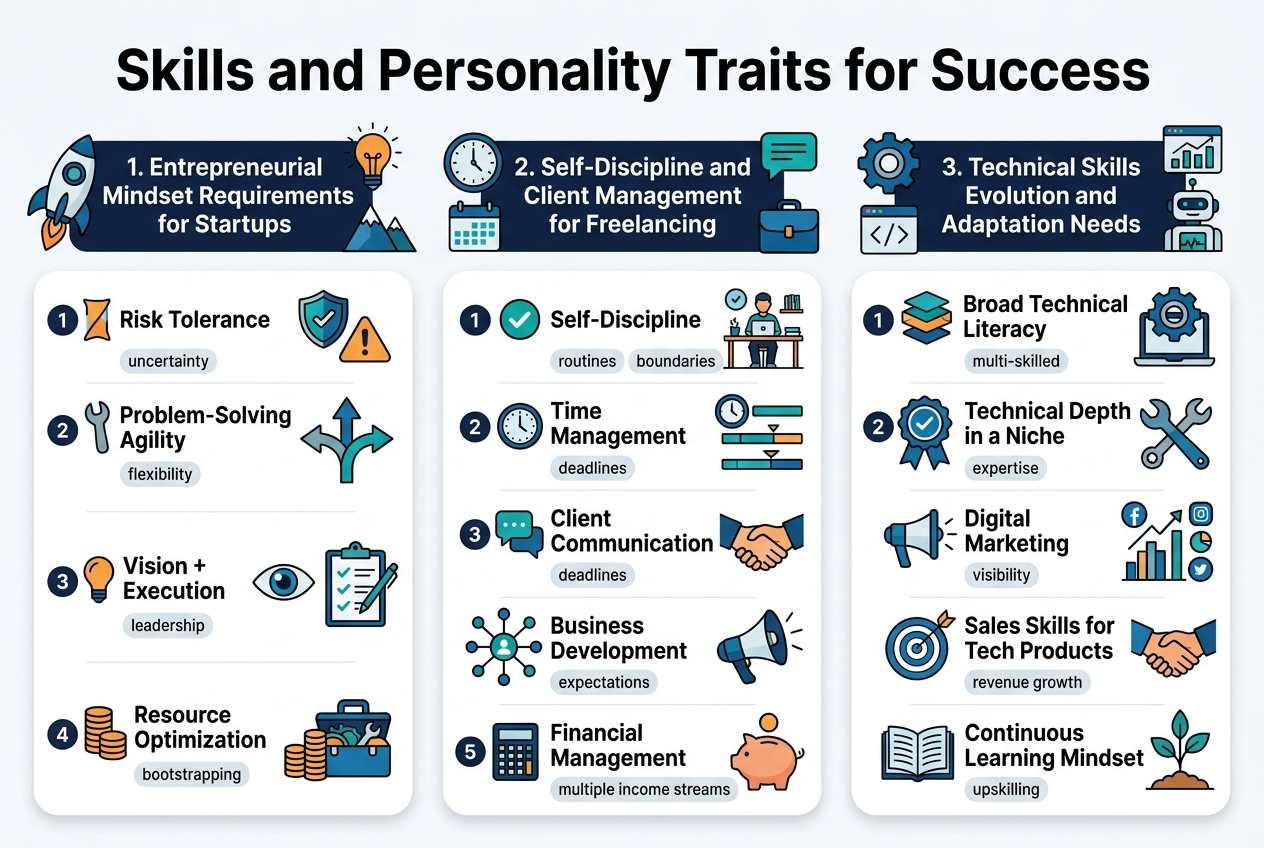
Starting a company demands a specific set of mental frameworks that separate dreamers from doers. Risk tolerance sits at the core – you’ll need to stomach uncertainty while making decisions with incomplete information. Successful startup founders embrace calculated risks, understanding that perfectionism often kills momentum.
Problem-solving agility becomes your daily currency. When you’re building something from scratch, roadblocks appear constantly. You’ll pivot strategies, adjust business models, and sometimes completely reinvent your approach. This requires mental flexibility and the ability to view failures as data points rather than defeats.
Vision paired with execution separates successful entrepreneurs from those who remain stuck in planning mode. You need to see opportunities others miss while simultaneously rolling up your sleeves to make things happen. Leadership skills naturally follow – you’ll inspire team members, attract investors, and convince customers to trust an unproven product.
Resource optimization becomes second nature when bootstrapping or managing limited funding. Successful entrepreneurs develop creative solutions using minimal resources, often wearing multiple hats until growth allows specialization.
Self-discipline and client management for freelancing
Freelancing success hinges on mastering yourself before managing clients. Without a boss breathing down your neck, self-discipline becomes your most valuable asset. Successful freelancers create structured routines, set firm boundaries between work and personal time, and resist the temptation to procrastinate when working from home.
Time management skills need surgical precision. You’ll juggle multiple projects, each with different deadlines and requirements. Top freelancers use project management tools, track billable hours religiously, and build buffer time into their schedules for unexpected revisions or scope creep.
Client communication separates amateur freelancers from seasoned professionals. This means setting clear expectations upfront, providing regular project updates, and handling difficult conversations with grace. You’ll need to educate clients about your process, manage their expectations, and sometimes push back on unreasonable demands while maintaining positive relationships.
Business development never stops. Unlike startup founders who might secure larger funding rounds, freelancers must consistently prospect for new clients while delivering quality work for existing ones. This requires networking skills, personal branding awareness, and the ability to position yourself as a valuable solution rather than just another service provider.
Financial management becomes crucial when income fluctuates monthly. Successful freelancers plan for dry spells, price their services appropriately, and develop multiple income streams to reduce dependency on any single client.
Technical skills evolution and adaptation needs
Technology moves fast, and both paths demand continuous learning, but with different focuses. Startup founders need broad technical literacy across multiple domains – enough to make informed decisions about product development, hiring, and strategic partnerships. You don’t need to code everything yourself, but understanding technical limitations and possibilities helps you communicate effectively with your team and make realistic promises to customers.
For freelancers, technical depth in your chosen specialty becomes your competitive advantage. Clients hire specialists, not generalists. Stay current with industry tools, emerging frameworks, and best practices within your niche. The most successful freelancers anticipate which skills their market will demand six months ahead and invest learning time accordingly.
Both paths require digital marketing fluency. Startups need growth hacking skills to acquire customers cost-effectively, while freelancers must master personal branding across social media platforms and professional networks. Understanding analytics, conversion optimization, and content creation helps both groups reach their target audiences effectively.
Automation tools increasingly level the playing field. Smart entrepreneurs and freelancers identify repetitive tasks and implement software solutions to handle routine work. This frees up mental bandwidth for higher-value activities like strategy development or creative problem-solving.
Data analysis skills become essential regardless of your path. Making decisions based on gut feelings alone won’t cut it anymore. Learn to interpret metrics, understand customer behavior patterns, and adjust your approach based on evidence rather than assumptions.
Work-Life Balance and Lifestyle Factors
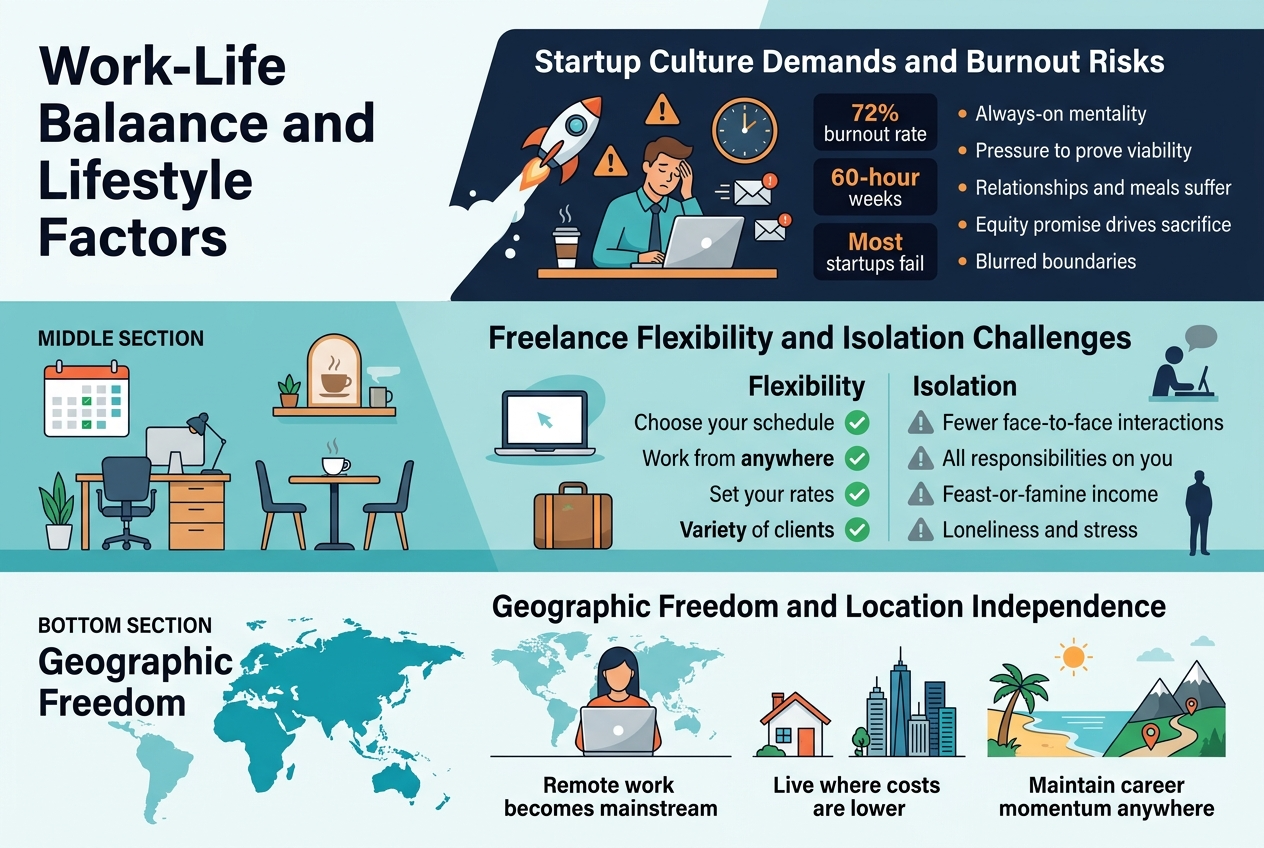
Startup Culture Demands and Burnout Risks
Working at a startup means embracing the “always-on” mentality. You’ll find yourself checking emails at midnight, brainstorming product features during weekend walks, and staying late because “we’re so close to a breakthrough.” The energy is addictive – you’re building something from scratch, making decisions that matter, and watching your ideas come to life in real-time.
But this intensity comes with serious downsides. Burnout rates in startups hover around 72%, significantly higher than traditional corporate jobs. The pressure to prove viability, secure funding, and outpace competitors creates an environment where 60-hour weeks become the norm rather than the exception. Many startup employees report difficulty maintaining relationships, skipping meals, and experiencing anxiety about company survival.
The equity promise often justifies these sacrifices – the dream that your stock options will pay off when the company goes public or gets acquired. Yet statistics show that most startups fail, leaving many workers with nothing but exhaustion and missed family dinners to show for their dedication.
Startup culture also blurs professional boundaries. Your coworkers become your social circle, company events replace personal time, and taking actual vacation days feels like abandoning your team. While some thrive in this high-stakes environment, others discover too late that the constant pressure takes a toll on their mental and physical health.
Freelance Flexibility and Isolation Challenges
Freelancing offers the ultimate control over your schedule. Want to take Tuesday off to explore a new hiking trail? Done. Need to pick up your kids from school every day at 3 PM? No problem. You set your rates, choose your clients, and design your workday around your life instead of the other way around.
This flexibility extends beyond scheduling. You can work from your home office, a coffee shop downtown, or a beach in Thailand. Many freelancers love the variety – one month you might help a tech startup with their marketing strategy, the next you’re designing logos for a local restaurant. This diversity keeps work interesting and builds a broad skill set.
However, the flip side of this freedom is isolation. Without office colleagues, water cooler conversations, or team lunches, many freelancers struggle with loneliness. You might go days without meaningful face-to-face interactions, especially if your clients communicate primarily through email or Slack.
The responsibility for everything – finding clients, handling contracts, managing invoices, dealing with difficult customers – falls entirely on your shoulders. There’s no HR department to handle disputes, no IT team when your computer crashes, and no manager to bounce ideas off. Some freelancers miss the collaborative energy and shared problem-solving that comes with traditional team environments.
The feast-or-famine cycle also creates stress. One month you might have more work than you can handle, the next you’re scrambling to find new projects. This unpredictability makes it hard to plan vacations or major purchases, adding financial anxiety to the isolation challenges.
Geographic Freedom and Location Independence
The 2020s marked a turning point for location independence, with remote work becoming mainstream across industries. For both startup employees and freelancers, this shift opened doors to living anywhere while maintaining career momentum.
Freelancers typically enjoy the most geographic freedom. Your clients care about results, not your zip code. You can live in a low-cost area while earning rates from expensive markets, effectively increasing your purchasing power. Many freelancers have embraced the digital nomad lifestyle, working from different countries while experiencing new cultures.
Startup workers have more variable location flexibility depending on company culture. Some startups operate fully remote, allowing employees to work from anywhere with decent internet. Others maintain hybrid models requiring occasional office visits, while traditional startups still expect daily in-person collaboration.
The financial implications of location independence are significant. A software developer earning San Francisco rates while living in Austin, Denver, or even internationally can dramatically improve their quality of life. Lower housing costs, shorter commutes, and access to different recreational opportunities become possible without sacrificing income.
However, location independence requires strong self-discipline and communication skills. Without the structure of an office environment, you must create your own productive workspace and maintain professional relationships through screens. Time zone differences can complicate collaboration, and some people struggle with the lack of separation between home and work life when both happen in the same space.
Building Your Professional Network and Brand
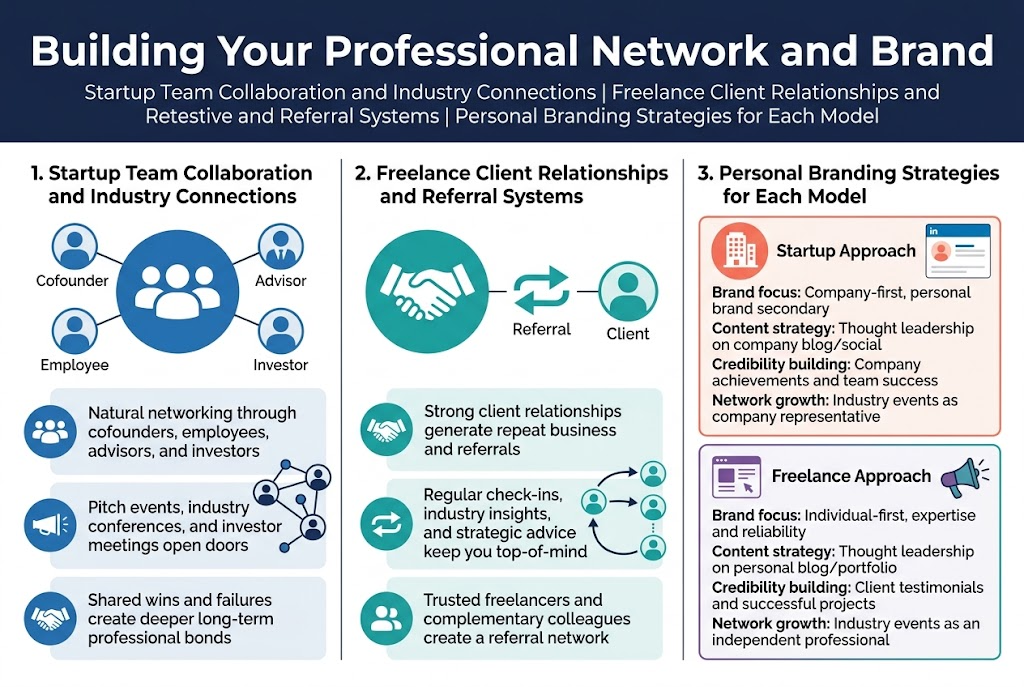
Startup Team Collaboration and Industry Connections
Working in a startup environment creates natural networking opportunities that freelancers often struggle to replicate. You’re constantly collaborating with cofounders, employees, advisors, and investors who become part of your professional circle. These relationships extend beyond your immediate team to include industry connections your colleagues bring to the table.
Startup networking happens organically through pitch events, industry conferences, and investor meetings. When you represent a company, doors open more easily than when you’re flying solo. VCs, potential partners, and industry leaders take meetings with startups, creating access to high-level connections that can benefit your career long-term.
The collaborative nature of startup work also builds deeper professional relationships. You’re solving problems together, sharing victories and failures, and creating bonds that outlast individual companies. Many successful entrepreneurs credit their startup experience for building the network that enabled their next venture.
Freelance Client Relationships and Referral Systems
Freelancing success heavily depends on building strong client relationships that generate repeat business and referrals. Unlike startup environments where networking happens naturally, freelancers must be intentional about relationship building. Every project becomes an opportunity to prove your value and earn trust.
Smart freelancers understand that client relationships extend beyond project completion. Regular check-ins, sharing industry insights, and offering strategic advice keep you top-of-mind when new opportunities arise. The best freelancers become trusted advisors rather than just service providers.
Referral systems become your primary growth engine. One satisfied client can refer you to their network, creating a multiplier effect. Building relationships with other freelancers in complementary fields also creates referral opportunities. When you can’t take on a project or it’s outside your expertise, referring it to a trusted colleague strengthens your professional network.
Personal Branding Strategies for Each Model
| Aspect | Startup Approach | Freelance Approach |
|---|---|---|
| Brand Focus | Company-first, personal brand secondary | Personal brand is everything |
| Content Strategy | Thought leadership on company blog/social | Own content across multiple platforms |
| Credibility Building | Company achievements and team success | Individual case studies and testimonials |
| Network Growth | Industry events as company representative | Direct outreach and content marketing |
Startup professionals often build their personal brand around their company’s mission and achievements. Your LinkedIn profile highlights your role in scaling the business, and your thought leadership content supports company goals. This approach works well for building industry credibility but can make transitioning between companies challenging.
Freelancers must treat themselves as their own brand from day one. Your personal website, portfolio, and social media presence directly impact your ability to win new clients. You need to consistently create content that demonstrates expertise and builds trust with potential clients.
The freelance branding approach requires more personal exposure and vulnerability. You’re putting yourself out there as the face of your business, which can be uncomfortable but is absolutely necessary for success. Your personal story, values, and unique perspective become key differentiators in a crowded marketplace.
Both paths benefit from authentic storytelling and consistent messaging across platforms. Whether you’re building a personal brand or representing a startup, authenticity resonates more than polished corporate speak.
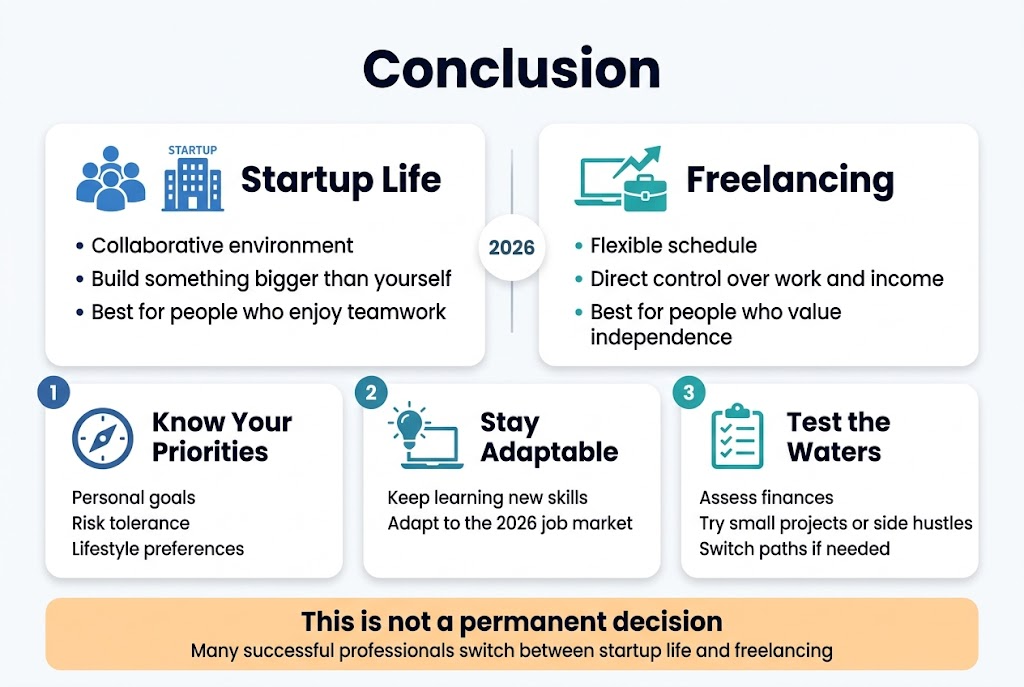
Both startup life and freelancing offer unique advantages that can lead to fulfilling careers in 2026. Your choice really comes down to your personal goals, risk tolerance, and lifestyle preferences. If you thrive in collaborative environments and want to build something bigger than yourself, the startup world might be your calling. On the other hand, if you value flexibility and want direct control over your work and income, freelancing could be the perfect fit.
The job market in 2026 will reward those who stay adaptable and keep learning new skills, regardless of which path you choose. Take some time to honestly assess your financial situation, career goals, and what kind of work environment makes you happiest. Remember, this isn’t a permanent decision – many successful professionals have switched between these paths throughout their careers. Start by testing the waters with small projects or side hustles to see which direction feels right for you.